Bragging Day
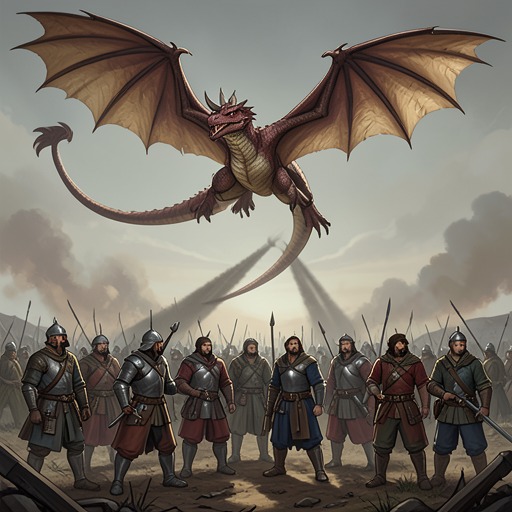
Vainqueur the DragonBragging Day is Vainqueur Knightsbane’s ceremonial attempt to prove that he is the greatest dragon of all. Conceived as a spectacle of treasure, princesses, family, and dominion, the celebration turns hoarding into public politics: Vainqueur does not merely possess wealth, but gathers an audience before whom that wealth can be recognized. Its success is therefore measured in several currencies at once—gold, dragon reputation, imperial authority, monster allegiance, and the prestige of having inspired imitation. Yet the event also carries an ironic cost. The hoard on display is diminished from the ideal treasure Vainqueur once sacrificed, the princesses are soon lost, and the festivities end in devastation even as the dragon receives official recognition as Emperor and Monster Lord.
Origins and Preparations
Bragging Day begins with Vainqueur’s desire to transform his expanded hoard into a public declaration of supremacy. After the hoard is cured of lead sickness, he judges it large enough to show to the rest of his kind, but he considers a princess indispensable to a genuine dragon hoard. He therefore orders Victor Dalton to find a well-paid quest involving a princess and plans to hold the celebration in two moons. The event is not an improvised party; it is a deliberate exercise in dragon status, designed to make private accumulation visible and to force comparison with other dragons.
The pressure becomes sharper when Vainqueur learns that his hated rival Icefang has caught twin princesses. Rather than allow Icefang to overshadow him at his own celebration, Vainqueur decides to parade three princesses. He also intends to obtain a Crest while hunting them, linking the spectacle to further advancement within the Class System. The preparations thus combine rivalry, acquisition, and self-improvement: Vainqueur wants not only a larger display, but proof that his authority can outshine a competitor’s achievement.
His guest list reflects the same ambition. Vainqueur plans to invite every dragon with whom he has remained in contact so that his wealth can appear before the broadest possible circle of his kind as a show of dominance. Family forms part of this display as well. Among the first arrivals are his favorite cousin, the brown wind dragon Genialissime; three black dragonlings placed in Vainqueur’s custody after his mating with Blightswamp; and his grown niece Jolie, a red dragon. The gathering therefore presents his hoard as both property and dynasty, surrounding imperial wealth with a visible network of dragon kin.
The Gathering at Murmurin
The event unfolds at night beneath the stars, with Vainqueur preparing to deliver his bragging speech. His surviving minions have assembled a large pile of treasure beside his statue. The pile is substantial, but Vainqueur recognizes that it is not the perfect golden marvel he sacrificed to the greedy goddess in order to revive Victor Dalton. That absence gives the celebration an undertone of loss: the spectacle is meant to establish his greatness, yet its central material symbol is less magnificent than the treasure that no longer exists.
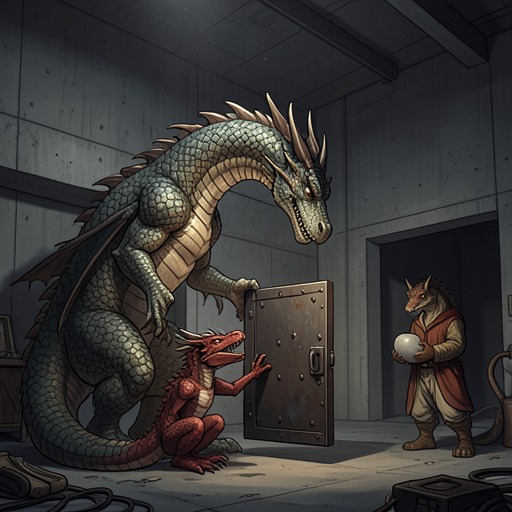
The arrival of the Kobold Rangers signals that the gathering is also a matter of security and organization. When someone frantically strikes the vault’s doorbell, Vainqueur and Victor look toward the gate, and magical mechanisms operated by spellcaster minions widen the vault door to reveal the arriving kobolds. The scene makes the celebration resemble an imperial court as much as a family reunion. Minions manage access, the castle’s enchantments regulate movement, and Vainqueur presides over a controlled space whose architecture and servants advertise his command.
Vainqueur refuses to let attention drift away from himself. Before the formal celebration, he promises his family a preview of his magnificent hoard, presenting the gesture as a reward for their quick arrival. He treats even hospitality as competition: the guests are not simply welcomed, but positioned as witnesses who must admire him. His confidence is intensified by his belief that a dragon’s superiority matters precisely because dragons are supposed to be awesome. Being the best of a weak species would mean little; being the strongest dragon would confirm the highest possible status.
The gathering also contains a minor generational echo. Jolie, still a young wyrm, has accumulated only a tiny hoard of copper coins and assorted treasures in her cave near the riverbank. Vainqueur places a princess doll on it for her first Bragging Day, while the dragons present offer positive reinforcement. He expects her to work toward fame when she is grown, and she later imagines organizing her own Bragging Day in roughly ten years, after another Princess Hunting Season. The scene turns Vainqueur’s personal ritual into a reproducible dragon custom, teaching a younger generation that hoard, princess, audience, and reputation belong together.
The Speech and Imperial Claim
When all guests and minions are present, Vainqueur summons their attention with a mighty roar. Victor Dalton supports him with a nod, embodying the faithful chief of staff whose presence is itself part of the dragon’s achievement. Vainqueur addresses dragons, manlings, and minions together, then directs attention to the domain’s food, wealth, and three princesses. The enumeration is theatrical: the repeated number transforms possession into a headline, while the princesses function as the crown jewel that completes the hoard’s public meaning.
Vainqueur also reminds the assembly that he sacrificed a greater golden hoard to revive Victor, now his prized dragonized chief of staff. This claim reframes resurrection as an act of aristocratic generosity and sacrifice, while simultaneously making Victor evidence of Vainqueur’s greatness. The chief of staff is not merely an associate who survived danger; he is a living monument to the wealth his master once possessed and the power Vainqueur claims to wield.
The speech reaches beyond personal boasting into state ideology. Vainqueur points to the surrounding lands and declares that he has founded an empire on enlightened dragon principles. He describes a country where minions never leave his service, even in death, and where demons may trade souls without paying taxes to manlings. The final principle is explicit: greed is law. Bragging Day therefore serves as a public founding myth for the Empire of Murmurin. The hoard is no longer confined to a vault; it has become territory, labor policy, taxation policy, and a theory of sovereignty.
The celebration’s greatest political effect is recognition. Vainqueur is acknowledged as Emperor by a powerful head of state, gains full dominion over Ishfania’s monsters, and earns newfound respect as a Monster Lord. The Class System responds to that recognition with advancement: he gains a level in Emperor and two levels in Kaiser. The event thus demonstrates the reciprocal relationship between spectacle and system. Vainqueur performs authority before witnesses, powerful recognition makes that authority legitimate, and the rules of advancement translate the legitimacy into formal status.
Triumph, Ruin, and Aftermath
The event also produces a cultural consequence that matters as much to Vainqueur as the political one. Victor Dalton declares that Vainqueur has inspired a new era of dragon adventuring, in the same way that Grandrake supposedly invented princess hunting. The claim turns Vainqueur from a boastful individual into an originator of a tradition. His personal obsession becomes a model for other dragons, and the celebration succeeds as propaganda even where it fails as a permanent preservation of wealth.
The guests depart praising the occasion, with one dragon calling it an amazing Bragging Day. Vainqueur promises a new one the following century and continues boasting about his discoveries. The promise shows that the ritual is inherently recurrent. No single display can permanently settle dragon prestige; each triumph creates the expectation of a larger future performance, extending rivalry and accumulation beyond the immediate celebration.
The princesses, however, do not remain as lasting trophies. After an elf wizard releases them from their crystals, they scream at the sight of two hundred dragons. Manling King Roland takes twenty minutes to calm them, and the manlings eventually carry them away on horses rather than accepting Vainqueur’s offer of one of his princess bags. Vainqueur attributes the disagreement to a culture clash, a comic explanation that also reveals the limits of his imperial worldview: he understands the princesses as components of a hoard, while the manlings treat their removal as a practical rescue.
After the guests leave, the physical consequences expose the celebration’s grotesque underside. The entire area resembles the aftermath of a volcanic disaster. No house is left unturned, and no sheep remains alive. Vainqueur then orders the Kobold Rangers, gnolls, mimics, and other servants to gather because the party is over. The command restores administrative order only after the feast has consumed the surrounding landscape. Public magnificence and collateral ruin are therefore inseparable: the same abundance that proves Vainqueur’s power also leaves a territory requiring reconstruction and control.
Narrative Significance
Bragging Day is a concentrated expression of Vainqueur’s governing logic. Wealth must be accumulated, displayed, witnessed, and converted into rank; relationships become evidence of power; resurrection becomes a debt-bearing gift; and even a child’s tiny hoard becomes a rehearsal for future prestige. The event’s gift economy is never innocent. Loans of treasure, revived life, ceremonial prizes, and political recognition create obligations, while Vainqueur’s chief of staff remains bound to him by an enormous claimed debt of twelve million, five hundred forty-five thousand, one hundred thirty-three gold coins in addition to a life debt for being raised as his prized servant.
Its central irony is that Vainqueur achieves the recognition he seeks without possessing the perfect hoard he imagined. The treasure beside his statue cannot equal the golden hoard sacrificed for Victor Dalton, the three princesses are taken away, and the imperial celebration leaves devastation behind. Nevertheless, the performance works. Vainqueur is recognized as Emperor and Monster Lord, his Class System status rises, and other dragons begin to regard his practices as the beginning of a new era. Bragging Day therefore turns failure of preservation into success of spectacle: what Vainqueur cannot keep as treasure, he preserves as reputation, institution, and recurring legend.